Building a Mossy Cliff Background in a 5-Gallon Closed Terrarium
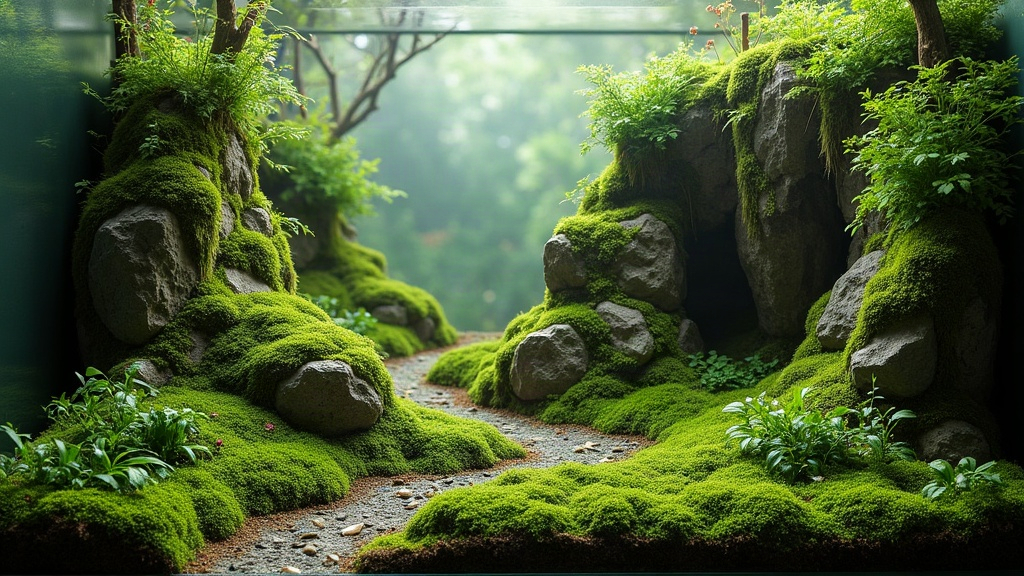
Building a Mossy Cliff Background in a 5-Gallon Closed Terrarium
A mossy cliff background turns a plain glass box into something that actually looks like a slice of forest. Suddenly there’s depth, a sense of height, a spot for your eye to land on instead of just a flat carpet of green. The trick is picking rot-resistant hardscape, keeping the structure light, using moss that’s actually suited for the job, and leaving enough open air space so the whole thing doesn’t turn into a swamp. Done right, a cliff background looks like it grew there naturally, not like a pile of rocks blocking light or choking your plants.
Why Build a Cliff Background?
A flat terrarium floor can still look nice, sure. But a vertical rock face does something a flat layout just can’t: it makes a small enclosure feel bigger than it is. It gives you a horizon line, a place for vines and creepers to climb, and a natural way to split the foreground from whatever’s happening in the back.
For a 5-gallon closed terrarium, aim to have the cliff take up roughly the back third of the tank. That leaves room for a planted floor, some visible glass, and a bit of open space so you’re not fighting the hardscape every time you need to trim something.
A mossy cliff setup fits particularly well with:
- Tropical forest-floor scenes
- Fern and fittonia plantings
- Miniature waterfall-inspired layouts
- Naturalistic display terrariums
- Low-maintenance humid moss collections
Choose Safe Materials First
Closed terrariums stay damp basically forever, so whatever you build with has to handle constant humidity without falling apart. Skip anything that rusts, leaches chemicals, breaks down within a few months, or releases residue you can’t identify.
Best Materials for the Cliff Structure
Pick one of these, or mix a few together:
- Cork bark: Light, textured, naturally rot-resistant, and genuinely easy to position. It’s forgiving if you get the angle wrong the first time.
- Dragon stone: Heavily textured, gives you that rugged, weathered-cliff look almost instantly.
- Lava rock: Porous and light, and moss grabs onto it well because of all the little holes.
- Slate: Great for layered ledges, but be careful, it can get surprisingly heavy for a small glass tank.
- Manzanita or spider wood: Adds root-like movement and breaks up the straight lines of stone or bark.
Cork bark is usually the easiest starting point if you’ve never done this before. Lean a curved piece against the back glass and you’ll get a convincing rock face in about five minutes.
What to Avoid
Painted decorations, treated lumber, dyed craft moss, or rocks pulled from areas that might have been sprayed with pesticides: all off the table. Same goes for sealing a background with expanding foam unless you actually know how to cure and cover it properly (a lot of people skip this step and regret it later). For a compact 5-gallon build, natural hardscape alone is usually simpler, cheaper, and honestly better looking.
Plan the Layout Before Adding Soil
Dry-fit everything outside the terrarium first. Stand back, look at it from the angle you’ll actually be viewing the tank from most of the time. A good composition usually has one taller side and one lower side, not a perfectly symmetrical wall stuck dead center (symmetry tends to look artificial in something this small).
Here’s a layout that works reliably:
- Place your tallest cork or stone piece in the back-left or back-right corner.
- Angle it slightly toward the center of the tank.
- Tuck smaller stones around its base so it looks anchored, not just propped up.
- Leave a narrow gap behind or beside the cliff, it adds real depth once moss fills in around it.
- Save the front third for low mosses, leaf litter, and small plants.
Keep the top of the cliff below the terrarium’s rim. This keeps it from pressing against the lid and lets condensation circulate the way it’s supposed to.
Build the Drainage and Substrate Layers
Closed terrariums have nowhere for excess water to go, so drainage isn’t optional. Even a flawless cliff background will fail if the soil underneath stays waterlogged.
Recommended Layering Order
From bottom to top:
- Drainage layer: 1 to 1.5 inches of rinsed LECA, gravel, or lava rock
- Optional separator: Fine mesh or landscape fabric
- Charcoal layer: A thin sprinkle of horticultural charcoal
- Growing substrate: 2 to 3 inches of airy terrarium soil mix
A solid substrate blend is coco coir, fine orchid bark, sphagnum moss, worm castings, and a bit of perlite or pumice thrown in. You want something that holds moisture without smothering root oxygen.
Set heavy stones directly on the drainage layer or on stable lower rocks, not on loose soil. Otherwise you’ll be re-leveling your cliff every other week as things settle.
Attach and Establish the Moss
For an authentic mossy cliff, use live terrarium moss, not the preserved decorative stuff. Preserved moss looks fine on day one, but it can’t grow, and it tends to fade fast once it’s sitting in constant humidity.
Suitable Moss Types
For an enclosed tropical setup, good options include:
- Sheet moss
- Cushion moss
- Fern moss
- Java moss
- Mood moss, if your humidity and light levels support it
Break the moss into small clumps rather than laying down one big sheet. Press those clumps into bark crevices, porous stone holes, or damp sphagnum tucked between ledges. Smaller pieces settle in more naturally and end up giving you that patchy, weathered look real cliffs have.
A little long-fiber sphagnum tucked behind the live moss helps hold moisture in place. Just don’t bury moss under thick substrate, it needs light and airflow hitting its surface to survive.
Use Natural Anchoring Methods
In a humid enclosure, moss often attaches on its own within a few weeks. For tricky vertical spots, a bit of fishing line, cotton thread, or a small clip will hold things in place until it roots. Go easy on the glue. Some adhesives are fine once fully cured, but mechanical support is a lot easier to undo if you decide to rearrange things later.
Select Plants That Match the Scale
A 5-gallon closed terrarium is not the place for fast-growing houseplants that’ll outgrow the tank in a month. Stick to slow growers that like high humidity and stay small.
Good options:
- Fittonia varieties for colorful foreground foliage
- Selaginella for a lush, fern-like texture
- Small-leaved creeping ficus, used sparingly
- Miniature ferns
- Pilea depressa
- Bucephalandra or tiny tropical aroids, if your conditions support them
Put taller species near the base of the cliff and keep low mosses closer to the front glass. That builds perspective without hiding your background behind a wall of leaves.
Light, Water, and Long-Term Care
Keep the terrarium in bright, indirect light. Direct sun on a sealed glass container is a fast way to cook everything inside, sometimes within a couple of hours.
Mist lightly, and only when the moss actually looks dry with little condensation visible. In a well-balanced closed terrarium, you’ll see a light haze on the glass for part of the day, not a wall of dripping droplets around the clock.
If condensation stays heavy for several days straight, crack the lid open for a few hours. If the substrate starts smelling sour, pull out any decaying material and give it extra ventilation until it clears up.
Trim fast-growing plants before they start shading out the moss on your cliff. Pull off fallen leaves right away too, especially if they’re decomposing against the background where you can’t easily reach them.
Conclusion
A mossy cliff background gives a 5-gallon closed terrarium real depth without needing any fancy equipment. Build it with stable natural materials, keep the substrate airy, pick plants that match the scale of the tank, and let the live moss establish at its own pace. With the right light and a bit of moisture discipline, that cliff becomes the centerpiece your whole miniature forest is built around.