Glass Cookie Jar vs Bell Jar for a Moss Terrarium: Which Wins?
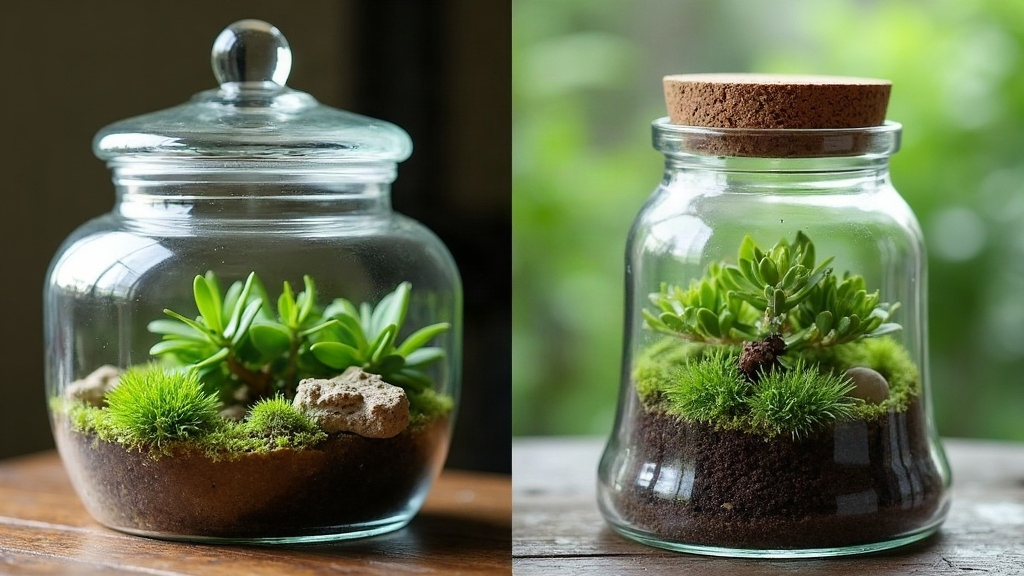
If you’re torn between a glass cookie jar and a bell jar for a self-sustaining moss terrarium, here’s the quick version: cookie jars win for beginners thanks to their tight gasket seals and wide-open access, while bell jars look gorgeous but demand a flat display dish and a bit more sealing finesse. Both can run a thriving, closed moss ecosystem for years. The real differences come down to seal reliability, humidity control, shape, and how hands-on you want to be over time.
Why Container Choice Matters So Much
A self-sustaining moss terrarium runs on a closed water cycle. Moisture rises off the soil and moss, hits the glass, condenses, and drips back down to start over. For that loop to keep working without mold, rot, or a bone-dry substrate, the container needs to hit a few marks:
- A reliable seal that actually traps humidity
- Enough interior height for the water cycle to settle into a rhythm
- Glass clear enough to let photosynthesis happen
- Stable footing so it doesn’t tip over on a shelf or crack at the base
Cookie jars and bell jars both tick these boxes. They just get there in different ways.
Glass Cookie Jar: The Practical Choice
A glass cookie jar typically has a wide mouth, straight or gently curved walls, and, this is the key part, a lid fitted with a rubber or silicone gasket.
Pros:
- Superior seal. That gasket locks the lid down airtight, so humidity stays predictable instead of a guessing game.
- Wide opening. Planting moss, placing rocks or wood, misting the inside walls, all of it is easier when you can fit your whole hand in.
- Self-contained unit. No separate base dish required. The jar itself holds the substrate and plants.
- Affordable and easy to find. Most kitchen stores carry them, usually somewhere between $10 and $25.
Cons:
- Less decorative than a bell jar. It reads as functional, not elegant.
- Straight sides make layered, dramatic landscaping trickier than a dome shape allows.
Best for: beginners, kitchen or office desks, anyone who’d rather not fuss over seal quality and just wants stable humidity.
Bell Jar: The Elegant Choice
A bell jar is that classic dome-shaped glass cover you’ve probably seen over a cheese board, set on a separate flat base made of wood, slate, or ceramic.
Pros:
- Stunning visual presentation. The dome shows off moss and miniature landscapes like nothing else. Great for a coffee table centerpiece or a gift.
- No fixed floor. You pick the base material yourself, a driftwood slice, a slab of stone, whatever fits the look you’re going for.
- Easy to lift off whenever you need to mist or rearrange something inside.
Cons:
- The seal lives or dies by how flush the rim sits against the base. A slightly warped piece of wood or an uneven stone slab, and humidity just leaks out.
- No built-in substrate well. You have to build the terrarium floor (drainage layer, charcoal, substrate) right on top of a flat base, and without a lip to hold things in, soil can spill over the edge.
- Taller domes tend to cost more ($25 to $60 or beyond) and the rim is more prone to chipping.
Best for: people who already have a terrarium or two under their belt, display pieces, anyone who cares more about looks than simplicity.
Head-to-Head Comparison
| Factor | Glass Cookie Jar | Bell Jar |
|---|---|---|
| Seal quality | Excellent (gasket) | Variable (rim-to-base) |
| Ease of planting | Easy (wide mouth) | Moderate (open base) |
| Humidity stability | High | Medium-High |
| Aesthetic appeal | Functional | Decorative |
| Cost | Lower | Higher |
| Soil containment | Built-in | Requires edging/lip |
Which Should You Choose?
- Go with a cookie jar if this is your first terrarium, you want to set it and mostly forget it, or it’ll sit somewhere with humidity swings, near a vent, a drafty window, or a radiator.
- Go with a bell jar if you already get how moss terrariums balance themselves, you want something worth showing off, and you’re willing to run a seal check first. A light mist test over 24 to 48 hours will show you exactly how condensation behaves before you commit any actual moss.
A Quick Tip for Either Container
No matter which one you pick, start with a drainage layer (gravel or LECA) topped with a thin layer of charcoal before adding your substrate. Skip this and you’re setting yourself up for standing water and root rot, which is, by a wide margin, the top reason closed terrariums fail. Container choice barely factors into that one.
Conclusion
Either a glass cookie jar or a bell jar can host a healthy, self-sustaining moss terrarium for years, no contest there. The cookie jar wins on practicality and seal reliability, which is exactly why it’s the smarter first pick. The bell jar wins on visual impact, and it rewards anyone patient enough to dial in the seal and build a proper base layer underneath. Pick based on your experience level and how much you care about the display, and you’ll end up with a tiny, thriving ecosystem either way.