Closed Terrarium vs Open Dish Garden for Baby's Tears
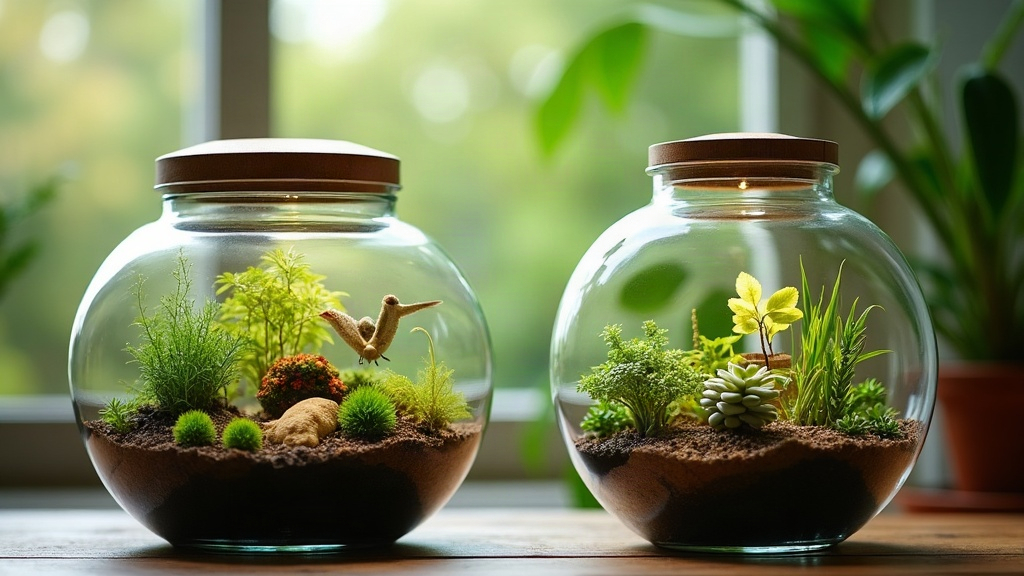
Baby’s Tears (Soleirolia soleirolii) is one of those plants that looks absolutely perfect in a terrarium: dense, mossy, lush, like a tiny forest floor. Right up until it turns to brown mush. The short answer: an open dish garden with excellent drainage generally beats a fully closed terrarium at preventing root rot, because Baby’s Tears wants constant moisture at the roots but can’t stand standing water or stagnant, saturated air. A closed terrarium can work too, but only if you’re careful with substrate layering and airflow. Here’s how to figure out which setup actually fits the way you garden.
Why Baby’s Tears Is Prone to Root Rot
Baby’s Tears has extremely fine, shallow roots and thin, delicate stems, almost hair-like when you look closely. It thrives in humidity above 50%, which is exactly why people reach for terrariums in the first place. But here’s the catch:
- Its roots need oxygen almost as badly as they need moisture.
- It has zero drought tolerance, so growers instinctively overwater to compensate.
- Its dense, low-growing foliage traps moisture right against the soil surface, which invites fungal and bacterial rot the moment airflow gets poor.
In other words, the plant wants humidity in the air but hates saturation in the soil. That single distinction is really the whole debate between closed and open setups.
Closed Terrarium: Pros and Risks
A sealed or mostly-sealed glass terrarium builds its own humidity cycle. Condensation forms on the glass, drips back down, and the moisture just keeps recirculating.
Pros:
- Near-constant 70-90% humidity, exactly what Baby’s Tears wants for lush foliage growth.
- Watering becomes rare, sometimes you go weeks without touching it.
- Looks stunning on display. That mounding, mossy carpet effect really only shows its best face in high humidity.
Risks:
- No evaporation route means any excess water has nowhere to go except further down into the substrate.
- Skip the drainage layer (LECA, lava rock, gravel) and roots end up sitting in a permanent moisture pocket.
- Poor air exchange lets anaerobic bacteria build up around the roots, and that’s the actual cause of root rot, not simply “too much water.”
- In crowded closed terrariums with several plant species, it’s usually Baby’s Tears that collapses first, since it’s the most rot-prone of the bunch.
Closed terrariums only work if you build them like a real ecosystem: drainage layer at the bottom, activated charcoal to filter out toxins, a breathable substrate mix (never compacted potting soil straight from the bag), and cracking the lid now and then instead of keeping it sealed 365 days a year.
Open Dish Garden: Pros and Risks
An open dish or shallow bowl setup relies on ambient room humidity plus whatever misting or watering you do by hand.
Pros:
- Excess moisture evaporates freely. No condensation trap, no hidden anaerobic pockets forming under the surface.
- Easier to catch overwatering early, soggy soil is right there in plain sight, not hidden behind fogged-up glass.
- Airflow across the surface cuts down on fungus gnats and mold, two of the most common terrarium headaches.
Risks:
- Humidity swings faster, especially in rooms running central heat or AC.
- Needs more frequent watering and misting, and inconsistency (not excess water) becomes the main threat here.
- In dry climates, edges of the foliage can crisp up fast without a humidity dome or a humidifier nearby.
Open dish gardens basically trade one problem for another: instead of root rot, you’re managing underwatering and browning. That’s usually the easier trade, since it’s visible and fixable with a quick soak rather than a slow, invisible death at the roots.
Side-by-Side: Which Prevents Root Rot Better?
| Factor | Closed Terrarium | Open Dish Garden |
|---|---|---|
| Humidity control | Excellent, but excessive | Moderate, needs upkeep |
| Drainage/airflow | Poor unless engineered | Naturally good |
| Root rot risk | Higher without drainage layer | Lower |
| Watering frequency | Rare | Frequent, small amounts |
| Maintenance skill needed | Higher (build once, monitor humidity) | Lower (routine care) |
Practical Recommendation
- Beginners or forgetful waterers: go with an open dish garden. The extra watering is a small price for a much lower root rot risk.
- Experienced terrarium builders: a closed terrarium works fine, as long as you add a real drainage layer, charcoal, and crack the lid a few times a week for gas exchange.
- Either setup: use a well-draining substrate (mix in perlite or fine bark), never let the container sit in standing water, and water only when the top layer feels dry to the touch, not on some fixed weekly schedule.
Conclusion
Root rot in Baby’s Tears is almost always a drainage and airflow problem wearing an “overwatering” disguise. Closed terrariums deliver gorgeous humidity, sure, but they demand deliberate engineering so water doesn’t just pool at the roots. Open dish gardens are more forgiving by design, letting excess moisture escape before it turns into a real problem. Want the lowest-maintenance path to a healthy patch of Baby’s Tears? Start with an open, well-drained dish, and only move to a sealed terrarium once you’re confident you can build in proper drainage and ventilation.