Terrarium Humidifier vs Manual Misting for Open Moss Displays
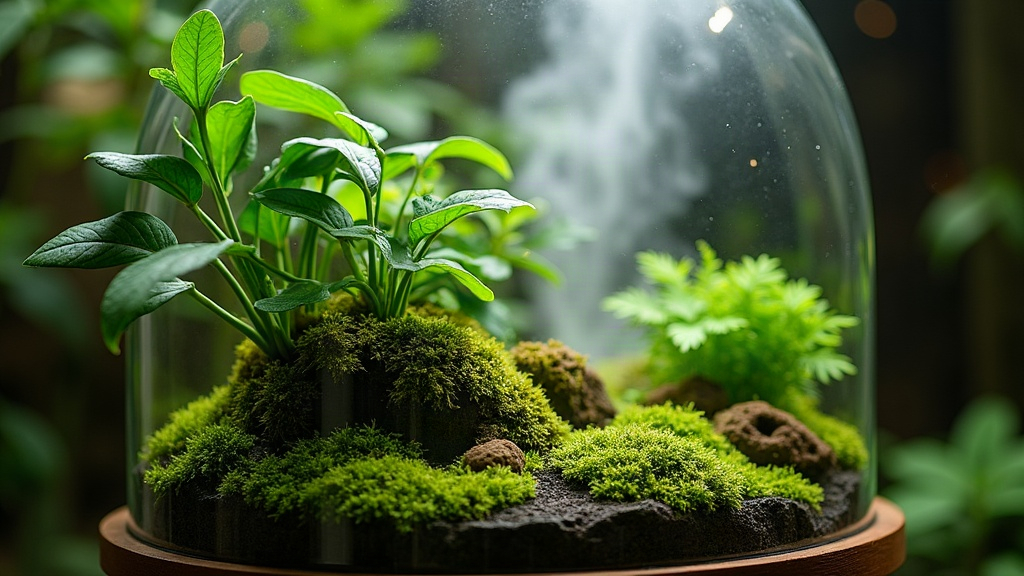
Large open moss displays live or die by humidity consistency, and that’s exactly where the terrarium humidifier vs manual misting debate matters most. For small closed jars, misting works fine because the glass traps moisture. But once you move into open-top displays (wall panels, large bowls, moss frames, cabinet-style builds over 10 gallons) manual misting starts to fall behind evaporation, while a terrarium humidifier can hold humidity steady without you lifting a finger. The right call depends on your display size, which moss species you’re growing, and honestly, how much hands-on time you’re willing to give it.
Why Open Displays Change the Equation
Closed terrariums run their own little water cycle. Condensation forms on the glass, drips back down, and humidity sits near 100% without any help. Open moss displays don’t get that luxury. There’s no lid, so moisture just leaves, drifting off into the room air. A few things follow from that:
- Humidity can swing from 90% right after misting down to under 40% within a few hours.
- Bigger surface area (open bowls, wall-mounted frames) dries out faster than a small sealed jar ever would.
- Room conditions, your HVAC vents, a drafty window, a sunny corner, all directly affect how fast the moss loses moisture.
This is the core problem manual misting simply can’t fix on its own, at least not for anything beyond a small personal setup.
Manual Misting: Pros and Cons
Pros
- Zero cost beyond a spray bottle (go with a fine mist nozzle, not a stream nozzle).
- Full control over timing, water type, and exactly how much you apply each session.
- Nothing to maintain: no filters, no mineral buildup, no motor that eventually dies on you.
- Works fine for small moss terrariums, vivarium accents, or low-stakes decorative pieces.
Cons
- Inconsistent humidity: most open displays dry out in 3-6 hours after a misting session, and sheet moss or cushion moss varieties like Leucobryum or Dicranum brown fast once they dry.
- Labor-intensive: a large display, say 3+ square feet of moss, often needs misting 2-4 times a day just to stay in good shape.
- Easy to overwater one spot: heavy spray on one section while the moss three inches away dries out, which leaves you with patchy, uneven growth.
- Not realistic if you travel, or if your schedule doesn’t allow for a strict routine.
Terrarium Humidifiers: Pros and Cons
Pros
- Consistent ambient humidity (60-85% depending on species) without you having to think about it.
- Programmable cycles: most ultrasonic units let you set on/off intervals, say 5 minutes on, 25 minutes off, tuned to match how fast your setup loses moisture.
- Even coverage: fine fog settles uniformly across wide, open layouts, which makes it ideal for moss walls and large bowl gardens.
- Frees up your time, which matters a lot for displays in offices, retail spaces, or homes where misting four times a day just isn’t happening.
Cons
- Upfront cost: basic ultrasonic units for terrariums run about $20-$60, while larger reservoir models with built-in timers go for $60-$150.
- Requires distilled or RO water: tap water leaves behind a white mineral dust, sometimes called “white fog,” that coats moss and glass alike.
- Needs upkeep: the transducer disk needs cleaning every 1-2 weeks or scale builds up and output drops noticeably.
- Can overshoot in a closed room, pushing ambient humidity high enough to bother nearby furniture or electronics if the space isn’t ventilated.
Which Setup Wins for Large Open Moss Displays?
Past roughly 2 square feet of open moss surface, the humidifier wins, no real contest. It comes down to physics: open-air evaporation moves faster than any human misting schedule can realistically keep up with, short of obsessive attention every couple hours. A $40 humidifier running on a 10-minute cycle timer will beat someone misting four times a day, every time, both for the moss and for your own sanity.
That said, misting by hand still earns its place:
- Hybrid approach: run a humidifier as your baseline (holding humidity around 55-65%) and hand-mist specific dry patches or newly transplanted moss sections when they need extra attention.
- Small or medium displays (under 2 square feet) can do just fine on misting alone, as long as you’re around enough to hit it 2-3 times a day.
- Budget-conscious setups: if cost is what’s driving the decision, a quality pump sprayer paired with a hygrometer to track the drops can get you by, just expect some browning at the edges when dry seasons hit.
Practical Setup Tips
- Pair any humidifier with a digital hygrometer placed right at moss level, not above the display. The readings differ more than you’d expect.
- Stick to distilled water in humidifiers; tap water leaves residue that can eventually smother the moss.
- On moss walls, aim the humidifier output across the surface rather than straight at one spot, adding a small fan if you need better distribution.
- Clean the humidifier reservoir weekly. Skipping this invites mold and biofilm, which can introduce pathogens straight to the moss.
Conclusion
For large open moss displays, a terrarium humidifier beats manual misting by a wide margin, mainly because it actually keeps up with the constant evaporation open setups are exposed to. Misting still has its place for smaller displays, or as a supplement for targeted dry spots, but once your moss garden passes a couple square feet, putting money into a programmable humidifier will save both your moss and your schedule.